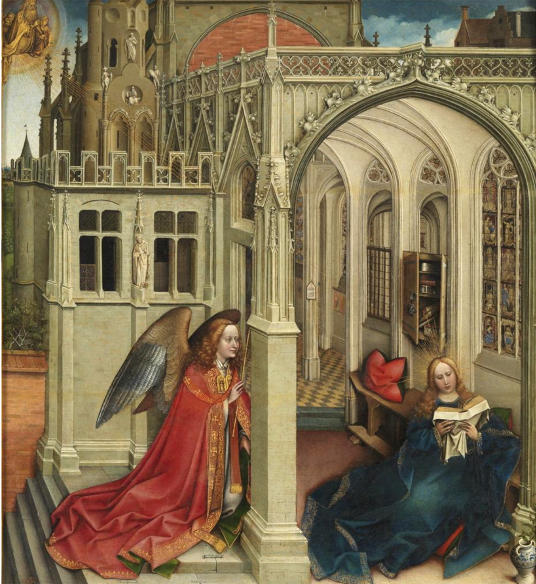
Iconographic interpretation of the temple as a theological symbol in images of the Annunciation of the 14th and 15th centuries
DOI:
https://doi.org/10.13130/fenestella/12672Keywords:
Templum Dei, Virgin Mary, Annunciation, Christ's Incarnation, Divine maternity, Jacquemart de Hesdin, Melchior Broederlam, Master of Boucicaut, Brothers of Limbourg, Robert Campin, Jan van Eyck, Barthélemy d'Eyck, Jean FouquetAbstract
This article seeks to highlight the important symbolic Christian meanings hidden in some textual metaphors of the Old Testament, such as “templum Dei”, “house of Wisdom”, “aula regia”, “Sancta Sanctorum”, “tabernacle”, “altar”, “ark” and other similar expressions related to worship spaces. To make our approach clearer, we will proceed according to two complementary analyses: first of all, we will analyse some exegesis offered on these metaphorical terms by certain Fathers and theologians of the Eastern and Western Churches; second, we will analyse some pictorial images of the Annunciation of the 14th and 15th centuries that include a temple or chapel in the scene. From this double analysis, of texts and images, it will be possible to conclude that the temple painted in those images constitutes a visual metaphor that illustrates the Christological and Mariological meanings brought to light by the Fathers and theologians when interpreting the aforementioned Old Testament textual metaphors.
References
Primary sources
Alvarez Campos S. (ed.), Corpus Marianum Patristicum, Burgos, II, 1970.
Ambrosius Mediolanensis, Epistula LXIII, 33, PL 16: coll. 1249-1250.
Andreas Cretensis, Oratio V. In sanctissimae Deiparae Dominae nostrae Annuntiationem, PG 97: coll. 894-895.
Anselmus Cantauriensis, Oratio LV, Ad eamdem sanctam Virginem Mariam, PL 158: col. 961.
Bonaventura de Balneoregio, I. De Purificatione B. Virginis Mariae. Sermo III (Obras de San Buenaventura, Edición bilingüe anotada y con introducciones por L. Amorós, IV, Teología mística, Madrid 1963: 564).
Biblia Sacra iuxta Vulgatam Clementinam. Nova editio, Madrid 200512.
Caelius Sedulius, Hymnus II, PL 19: coll. 763-764.
Cyrillus Alexandrinus, Commentarius in S. Joannis Evangelium. Liber Quartus, IV, 3, PG 73: col. 615.
Ephraem Syrus, Hymni de Nativitate 17, 5 (Alvarez Campos 1970: 492).
Ephraem Syrus, Carmina Sogita 1, 38 and 40 (Alvarez Campos 1970: 517).
Germanus Constantinopolitanus, In Praesentationem SS. Deiparae. Sermo I, PG 98: col. 306.
Iohannes Damascenus, Homilia II In Nativitatem B.V. Mariae, 7, PG 96: col. 690.
Maximus Taurinensis, Homilia V. De eadem [ante natale Domini], PL 57: col. 235.
Modestus Hierosolymitanus, Encomium in Dormitionem Sanctissimae Dominae Nostrae Deiparae semperque Virginis Mariae, PG 86-2: col. 3285.
Petrus Chrysologus, Sermo LIX. In symbolum apostolorum, PL 52: col. 364.
Petrus Damianus, Sermo XLV. II. In Nativitate Beatissimae Virginis Mariae (VIII Sept.), PL 144: col. 741.
Proclus Constantinopolitanus, Oratio III. De Incarnatione Domini nostri Jesu Christi, 1, PG 65: col. 707.
Proclus Constantinopolitanus, Oratio VI. Laudatio sanctae Dei genitricis Mariae, PG 65: col. 754.
Zeno Veronensis, Tractatuum Sancti Zenonis episcopi veronensis Liber Secundus. Tractatus VIII. De Nativitate Domini II, PL 11: coll. 413-415.
Secondary Literature
Avril F., Jean Fouquet, peintre et enlumineur du XV siècle (catalogue de l'exposition, BnF), Paris 2003.
Ferré R.-M., Le retable de l'Annonciation d'Aix de Barthélemy d'Eyck: Une pratique originale de la vision entre peinture et performance, «European Medieval Drama» 12 (2008): 163-183.
Friedländer M. J. (a), Early Netherlandish painting, 1, The van Eycks-Petrus Christus, Leiden 1967.
Friedländer M. J. (b), Early Netherlandish painting, 2, Rogier van der Weyden and the Master of Flemalle, Leyden 1967.
Harbison C., Jan van Eyck. The Play of Realism, London 1991.
Laclotte M., Thiébaut D. et alii, L'École d'Avignon, Paris 1983.
Nishino Y., Le Triptyque de l'Annonciation d'Aix et son Programme iconographique,
«Arti¬bus et Historiae» XX, 39 (1999): 55-74.
Panofsky E., Les primitifs flamands, Paris 2012 (1953).
Réau L., Iconographie de l'Art Chrétien, II, Iconographie de la Bible, 2, Nouveau Testament, Paris 1957.
Reynaud N., Barthélémy d'Eyck avant 1450, «Revue de l'Art» 84 (1989): 22-43.
Reynaud N., Jean Fouquet – Les Heures d'Étienne Chevalier, Dijon 2006.
Robb D. M., The Iconography of the Annunciation in the Fourteenth and Fifteenth Centuries, «The Art Bulletin» 18 (1936): 480-526.
Salvador González J. M., Dei Templum oblatum Deo est in templo. Aproximación iconográfica a La Presentación de María al templo en la pintura italiana del Trecento de-sde sus fuentes apócrifas, «De Medio Aevo» 5 (2014/1): 95-118.
Salvador-González J. M., O Virgo, templum Dei sanctum. Simbolismo del templo en imágenes de la Virgen María en los siglos XIV-XV según exégesis patrísticas y teológicas, «Ilur. Revista de Ciencias de las Religiones», 22 (2017): 359-398 [http://dx.doi.org/10.5209/ILUR.57421].
Schiller G., Iconography of Christian Art, I, London 1971.
Sterling Ch., Schaefer C., Jean Fouquet. Les Heures d'Étienne Chevalier, Paris 1971.
Simpson A., Van Eyck. The complete works, London 2007.
Thürlemann F., Robert Campin. A monographic study with critical catalogue, Munich 2002.